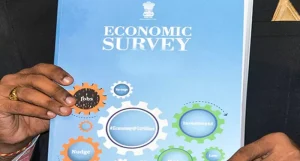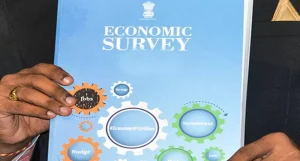
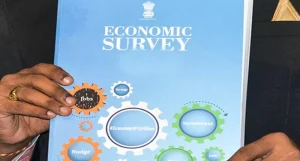
New Delhi: India must focus on building enduring national capabilities and economic sovereignty in the face of shrinking space for rules-based trading, anti-immigrant stance, weaponisation of energy sources and growing use of export controls in critical sectors, the Economic Survey said Thursday.
It said the global economy has been subjected to “multiple upheavals” and the “most disruptive” amongst these disturbances was the imposition of tariffs by the US on imports from its trade partners.
In a world where economic relationships are increasingly strategic and contested, the ability to learn becomes a core element of “statecraft”, it said, noting that India must build enduring national capabilities to deal with the challenging geopolitical scenario.
The assessment comes against the backdrop of growing concerns over the Trump administration’s policies on trade, tariffs and immigration, China’s export control measures relating to critical minerals and increasing disquiet in the West over India’s energy ties with Russia.
The Economic Survey 2025-26, that was tabled in Parliament, referring to geopolitical and economic turbulence, said strategic competition is increasingly fuelling trade wars, while nations vie for access to critical minerals and technological resources in a manner “reminiscent of a new colonial scramble”.
The recent experience illustrated that “economic interdependence, once viewed as a source of mutual stability, is now increasingly perceived as a channel of vulnerability”, it said.
“Across regions, the resurgence of ultra-nationalism, rooted in claims of cultural superiority and an anti-immigrant stance, is increasingly shaping political and policy choices,” it said.
“This shift is narrowing the space for multilateral cooperation and rule-based trading, while hardening domestic borders and constraining labour mobility. Overall, this has reoriented economic strategies toward inward-looking priorities,” it noted.
The survey said a growing number of nations are becoming increasingly sceptical of free trade and multilateral institutions, which are believed to have led to large and concentrated global trade imbalances.
The survey also appeared to flag concerns over China utilising its fiscal power to construct infrastructure in other countries through its Belt and Road Initiative, saying the aim is to enhance Beijing’s “trade and economic dominance”.
“Against this backdrop, India’s reforms and economic performance over the previous decade have helped it stay relevant and resilient, capable of withstanding and adapting to external economic pressures and statecraft without disproportionate disruption.”
“We must now move a step further and focus on deliberately cultivating strategic indispensability,” it said.
The Economic Survey also flagged concerns over Washington’s policy on tariffs.
“Since the last version of the Economic Survey was published, the global economy has been subjected to multiple upheavals. The most disruptive amongst these disturbances was the imposition of tariffs by the USA on imports from its trade partners,” it said.
The survey said in today’s fragmented global economy, the capacity to learn without dependence becomes an essential strategic skill.
“Swadeshi is inevitable and necessary,” it said.
The strategic context has shifted in ways that materially alter the calculus of openness, it said.
“Export controls, technology denial regimes, carbon border mechanisms, and industrial policy in the West and East alike signal the end of naive globalisation,” it said.
“We operate in an environment where access to inputs, technologies, and markets cannot be assumed to be frictionless or permanent. In such circumstances, Swadeshi becomes a defensive as well as offensive policy lever: a means to ensure continuity of production in the face of external shocks.”
The survey said the solution lies in a pathway to build enduring national capabilities that reinforce economic sovereignty.
“The policy question is no longer whether the state should encourage Swadeshi, but how it should do so without undermining efficiency, innovation, or global integration,” it said.
Orissa POST – Odisha’s No.1 English Daily